
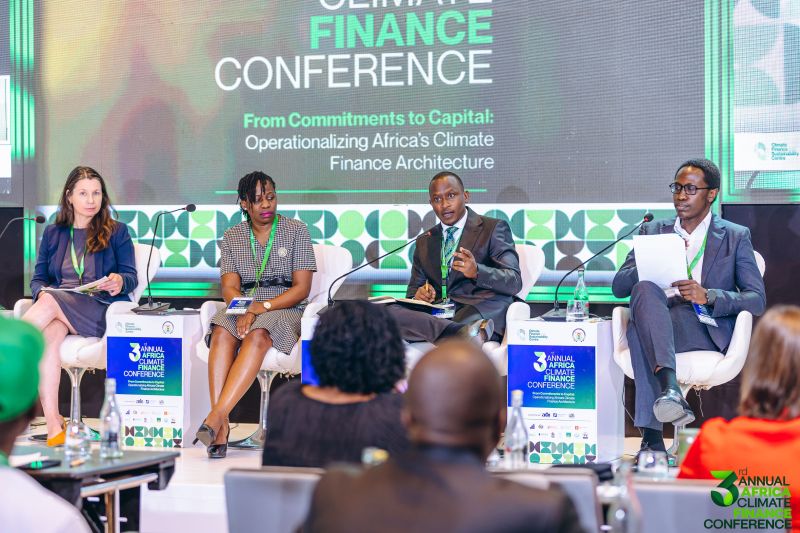
At the 3rd Annual Africa Climate Finance Conference in Kampala, UGEFA highlighted how green enterprises and financial institutions can work together to turn climate finance commitments into investment.
Kampala, Uganda – The 3rd Annual Africa Climate Finance Conference brought together government representatives, financial institutions, researchers, SMEs and development partners in Kampala on 1 and 2 September. The conference examined why climate capital is not reaching African enterprises at the pace and scale required. Dr Lena Giesbert from adelphi global represented the EU-funded Uganda Green Enterprise Finance Accelerator (UGEFA) on a panel on “Mobilising new and diverse sources of capital”. She joined Dr Francis Mwesigye of Uganda Development Bank and Anne Marie Mwaka Sabano of aBi Finance. Basil Kandaya from Convergence Blended Finance moderated the discussion. The panel drew on UGEFA’s experience of connecting green SMEs with commercial banks and explored how climate finance commitments can become capital that reaches enterprises on the ground.
The conference’s opening session drew on the newly launched Africa’s Climate Finance Outlook 2026. Speakers highlighted a persistent gap between the climate finance that exists in principle and its uptake and implementation at the local level. This gap does not necessarily reflect a lack of bankable pipelines or risk sharing mechanisms. Instead, the more difficult task is often building the capacity to scale and channel existing capital to local enterprises.
Dr Giesbert’s contribution placed UGEFA within this challenge. Green small and medium-sized enterprises (SMEs) face the familiar constraints associated with limited track records and insufficient collateral. They also face an additional obstacle: loan officers may lack the technical familiarity needed to assess unfamiliar green business models. This can make risk assessment difficult and costly, even where the underlying business case is sound.
A small circular economy enterprise that turns plastic waste into construction materials illustrates the challenge. The business may offer a commercially promising solution, but its model can remain difficult for a conventional credit process to assess. As a result, the enterprise may face higher financing costs or exclusion from finance altogether.

According to Dr Giesbert, UGEFA’s work with banks rests on three elements. First, UGEFA supports enterprises to develop credible investment cases that are ready for bank assessment. The structured selection process also gives banks an additional indication of the enterprise’s quality and potential, helping to address information gaps before a loan application reaches a branch.
Second, UGEFA shares part of the transaction risk with lending banks through tailored funding instruments that combine grant support with commercial loans. This can reduce the exposure and repayment burden that might otherwise make a transaction unattractive to a bank.
Third, UGEFA helps banks build their own capacity and strategic position. Through the UGEFA Green Finance Academy, partner banks train loan officers and other staff to assess green business models and investments. They also work on practical green loan products, helping to operationalise Uganda’s Green Taxonomy and position themselves in a growing market. This early engagement may also improve their access to larger green finance credit lines from other climate finance providers.
Dr Giesbert emphasised that UGEFA’s approach combines these elements rather than treating them as standalone solutions. The model can therefore be adapted to different types of financial institutions and target groups, as well as to different national taxonomies and market conditions.
This approach reflected another theme that ran through the conference: green finance products need to be simple and understandable for the people who use them. Dr Giesbert extended this point by highlighting the need for understanding in both directions. SMEs need support to present credible investment cases, while banks need the skills to assess and price green business models with confidence. This capacity needs to extend beyond a bank’s sustainability team and reach the staff involved in everyday lending decisions.
The question of reach will also shape UGEFA’s Green Finance Dialogue Forum on 4th of November. The forum will explore the links between gender responsive financing and green finance, with a focus on financing women led enterprises as part of Uganda’s transition to a green economy.
UGEFA looks forward to continuing the conversation with the participants and partners who joined the Africa Climate Finance Conference in Kampala.


